 Professional Service
Deep Kitchen Cleaning
A kitchen gets used harder than any other room in the house, and it shows in places most people never look. Oil vapour from daily cooking settles on cabinet fronts, tile grout and the underside of shelves, then bonds to those surfaces as it cools. Wiping handles the fresh layer. It does very little about the older one underneath.
SpotLess Cleaning Services handles kitchen cleaning across Lucknow for flats, independent houses and small commercial kitchens. Call or WhatsApp +91 80903 92388 to book, or read on for what the service covers, what it costs and answers to the questions people usually ask first.
What Is Professional Kitchen Cleaning?
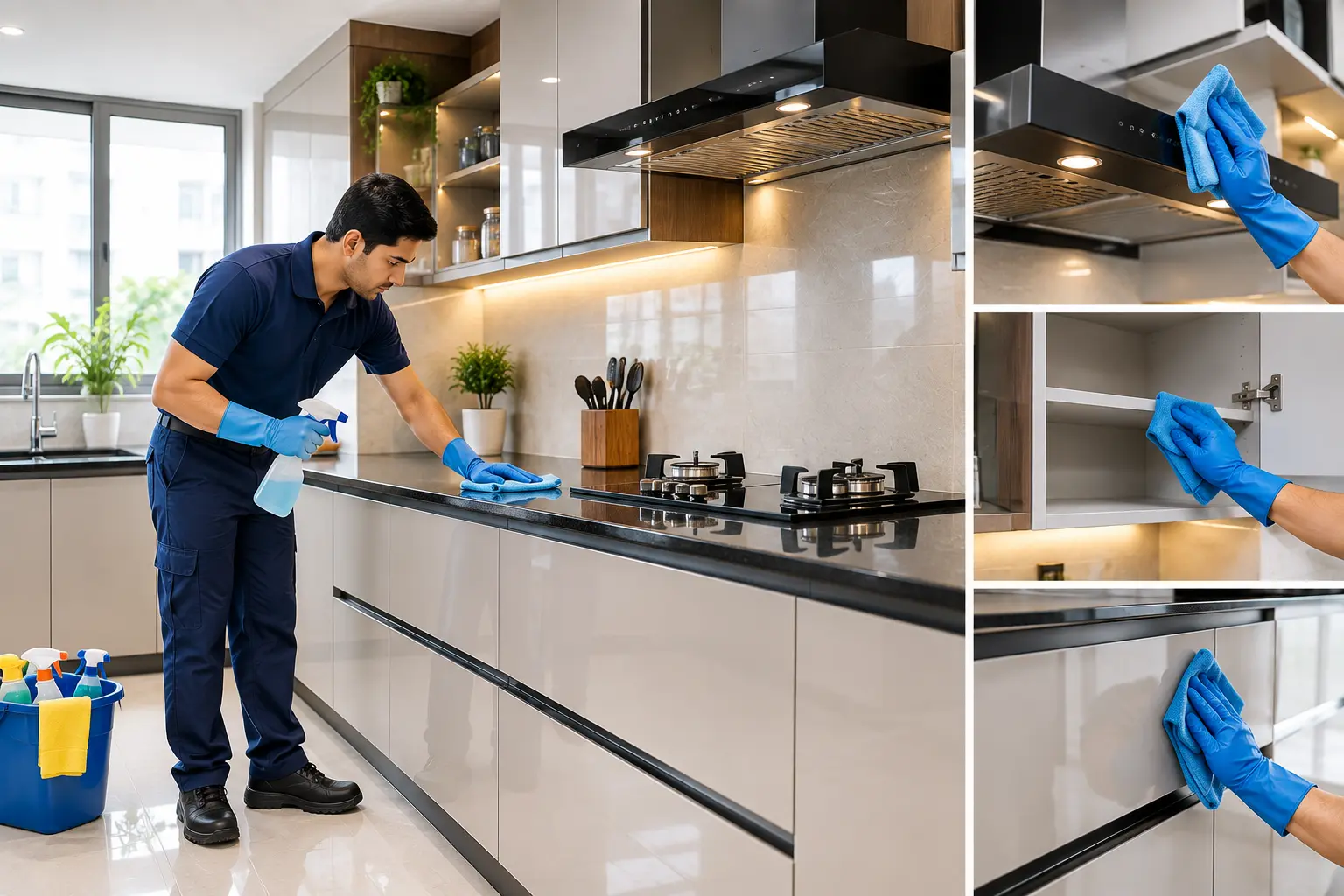
Professional kitchen cleaning is a detailed clean of every accessible surface in the kitchen using degreasing agents strong enough to break down cooked-on oil, which household dish soap generally cannot do. It covers the platform and backsplash, cabinet exteriors and interiors, tiles and grout lines, the sink and drain area, the stove and burners, appliance exteriors, the exhaust fan, switchboards and the floor.
The reason it exists as a separate service is that kitchen dirt behaves differently from dirt anywhere else in the house. Dust on a bedroom shelf sits loose and lifts with a cloth. Kitchen grease starts as airborne vapour, settles as a film, then polymerises into a sticky layer that traps more dust and grease on top of it. Once that has happened, removing it takes a proper degreasing agent and time for it to work, not more scrubbing.
Kitchen Cleaning vs. Deep Kitchen Cleaning
The two terms get used interchangeably, but they describe different levels of work.
Regular Kitchen Cleaning | Deep Kitchen Cleaning |
| Wiping visible surfaces and washing the sink | Degreasing every surface including cabinet interiors and shelf undersides |
| Part of daily or weekly household upkeep | Done every few months to reset accumulated buildup |
| Cleans what is easily reachable | Reaches behind the stove, under shelves and into grout lines |
| Light detergent or dish soap | Commercial-grade degreasers with dwell time |
| Chimney and exhaust untouched | Chimney hood, filters and exhaust fan addressed |
Most households need both. Daily cleaning keeps the kitchen usable. A deep clean every few months handles what daily cleaning has been quietly leaving behind.
Why Kitchen Grease Builds Up Faster Than You Think
Indian cooking produces more airborne oil than most cuisines. Tempering, deep frying and high-flame cooking all throw fine oil droplets into the air, which then travel further than the stove area and settle across the room. In a typical Lucknow kitchen with limited ventilation, a good share of that lands on cabinet fronts, the ceiling above the stove and the tile wall behind the platform.
Lucknow's dust levels make it worse. Fine dust settles onto surfaces that already carry an oil film and sticks to it instead of blowing off, which is why a kitchen shelf feels tacky rather than dusty. During monsoon, higher humidity slows evaporation and makes the film hold longer, and damp corners near the sink become a reasonable place for mould to start.
Signs Your Kitchen Needs a Deep Clean
Cabinet handles or fronts that feel slightly sticky even after wiping usually mean the oil film has set. Tile grout that has turned yellow or brown, a sink area that smells even after washing, an exhaust fan that runs loudly or moves less air than it used to, and stove burners that have gone from silver to brown are all the same underlying problem. So is a sudden increase in cockroach or ant activity, since both are drawn to residue in exactly the places routine cleaning misses.
If it has been more than four to six months since a proper deep clean, most Lucknow kitchens are due regardless of how tidy they look.
Our Kitchen Cleaning Checklist, Area by Area
We work through the kitchen in a fixed order so nothing gets skipped, adjusting the method to the surface.
Countertops, Platform and Backsplash
The platform, the backsplash behind it and any tiled or stone surround are degreased, scrubbed and wiped down. Granite and quartz platforms are treated with agents suited to stone, since strongly acidic cleaners can dull a polished finish over time.
Cabinets, Trolleys and Drawers
This is where the difference between a routine clean and a professional one shows most clearly. Cabinet exteriors, handles, shutter edges and the underside of each shelf are degreased, and interiors are wiped out once the contents are cleared. Sticky drawer runners and trolley rails get particular attention, since built-up grease in the channel is what makes a trolley stiff or noisy long before the hardware actually fails.
Kitchen Tiles and Walls
Tiles are scrubbed and grout lines worked individually where discoloration has set in. Grout is porous, so it absorbs oil and stains rather than repelling it, which is why a kitchen wall can look clean while the lines between the tiles stay dark.
Sink, Taps and Drain Area
The sink, drainboard, taps and fittings are descaled to remove hard water deposits, then disinfected. The visible drain opening and surrounding area are cleaned, and the sink trap area is wiped where accessible.
Gas Stove, Hob and Burners
Burner caps, grates and the stove body are degreased and scrubbed. Burnt-on spill marks around burner rings are worked on with a scraper where the surface allows it. Hob glass is cleaned without abrasives that would scratch it.
Appliance Exteriors
The outer surfaces of the fridge, microwave, oven, toaster and water purifier are cleaned, including door seals, handles and the sides people rarely reach. Appliance interiors are available as an add-on rather than part of the standard scope.
Exhaust Fan, Ventilator and Switchboards
The exhaust fan blades and housing, window ventilators, switchboards, light fittings and any accessible ceiling area above the stove are cleaned. Exhaust fan blades usually carry the heaviest grease load in the entire kitchen.
Kitchen Floor
Floors are scrubbed rather than mopped, with extra attention to the area in front of the stove and around the sink where oil and water combine into a film that regular mopping spreads instead of removing. Corners and the skirting edge are done by hand.
What Is Not Included
A few things sit outside the standard service so the price stays predictable. We do not wash utensils, crockery or cookware, and we do not empty and repack cabinet contents unless you have booked the empty-kitchen option. Moving heavy appliances such as a full-size fridge or a built-in oven is outside scope, as is any repair work, chimney motor servicing or pest treatment. Appliance interiors, cabinet repainting and pest control can all be arranged separately if you need them.
Kitchen Chimney Cleaning in Lucknow
Chimney cleaning is priced and booked separately from kitchen cleaning, because it is a genuinely different job with different equipment and its own time requirement. You can book it on its own or add it to a kitchen deep clean.
A chimney works by pulling oil-laden air through a filter before venting it out. That filter does its job by catching grease, which means it clogs steadily with use. Once it is saturated, suction drops, the motor works harder, and oil that should have been trapped starts condensing on the hood and dripping back down onto the stove. Most people notice the smell or the reduced suction well before they think to check the filter.
We clean the hood exterior and interior, remove and degrease baffle or mesh filters, clean the oil collector cup, and wipe down the accessible duct mouth. Motor servicing and electrical repair are not part of cleaning, and if we find a fault we will tell you rather than attempt it.
Chimney Brands We Service
We clean chimneys across the common brands sold in Lucknow, including Faber, Elica, Glen, Hindware, Kaff, Sunflame and Bosch, along with unbranded and locally fabricated hoods. Filter type matters more than brand for the actual cleaning, since baffle, mesh and charcoal filters each come apart differently.
Modular vs. Traditional Kitchen Cleaning
A modular kitchen has more separate surfaces than a traditional one. Every shutter, every drawer front, every runner and every internal shelf is an individual thing to clean, and the laminate or acrylic finishes used on most modular units need gentler agents than tile or stone would tolerate. More units generally means more time.
A traditional kitchen with a concrete platform, open shelving and tiled walls usually has fewer separate parts but more exposed surface area, and the tile and grout work tends to take longer. Open shelves also collect more airborne oil than closed cabinets, simply because nothing is shielding them.
Neither type is harder overall. They just spend time in different places, which is worth knowing when you compare quotes from two companies and the numbers come back different.
Empty Kitchen vs. Occupied Kitchen Cleaning
An occupied kitchen is cleaned with your utensils, jars and groceries still in place. We clean around them, clearing and replacing shelf contents section by section as we go. It takes longer, and cabinet interiors get a wipe-down rather than a full clear-out.
An empty kitchen, where cabinets and shelves have been cleared beforehand, is faster and more thorough. Every interior surface is fully accessible, nothing has to be moved twice, and the result is noticeably better. If you are able to empty your cabinets before the visit, it costs less and you get more.
This is also the version most people want before moving into a new home, which is covered under our move-in and move-out cleaning service if the whole property needs attention rather than just the kitchen.
Our Kitchen Cleaning Process
The technician starts by inspecting the kitchen, noting the finish types, the condition of the tiles and grout, and any specific problem areas, then confirms the price before anything begins. Dry dusting comes first, clearing cobwebs and loose dust from ceilings, corners, ventilators and shelf tops so that none of it falls onto surfaces cleaned later.
Degreasing agents are then applied to the platform, tiles, cabinet fronts, stove and exhaust fan and left to dwell. This waiting period is the part that actually does the work, and rushing it is the most common reason a kitchen clean underdelivers. Once the grease has softened, every surface is scrubbed by hand or with a machine depending on what it can take, then wiped and rinsed so no cleaning residue is left behind on food-contact surfaces.
The sink and drain area are descaled and disinfected, the floor is scrubbed last, and the technician walks the kitchen with you before finishing. A standard occupied kitchen takes roughly two to four hours. Empty kitchens are faster. Adding chimney cleaning usually adds another forty-five minutes to an hour.
Kitchen Cleaning Price in Lucknow
Service | Starting Price |
| Kitchen deep cleaning (occupied) | ₹1,499 |
| Kitchen deep cleaning (empty, cabinets cleared) | ₹1,299 |
| Kitchen deep cleaning with chimney | ₹1,999 |
| Chimney cleaning only | ₹699 |
| Commercial kitchen | From ₹2,999, after inspection |
What Affects Your Kitchen Cleaning Cost
Kitchen size and the number of cabinet units matter most, since a large modular kitchen has several times the surface area of a compact one. Beyond that, how long it has been since the last deep clean makes a real difference, because older grease needs longer dwell time and more passes. Whether the kitchen is occupied or cleared, whether the chimney is included, and whether the tiles and grout need individual attention all shift the final figure.
We confirm the price after inspecting the kitchen and before starting work. It does not change afterwards.
What You Need to Provide
The technician arrives with all cleaning agents, scrubbing tools and equipment. From your side we need a working electrical point, running water, and a stool or ladder if your kitchen has high cabinets or an unusually high ceiling. If you are booking the empty-kitchen option, cabinets and shelves should be cleared before the team arrives.
How Often Should a Kitchen Be Deep Cleaned?
For a household that cooks daily, every three to four months works well. Kitchens with heavy frying, larger families or poor ventilation do better closer to every two months. A kitchen used lightly, or one in a home where most cooking is low-oil, can usually stretch to twice a year.
The chimney filter is on a shorter cycle than the kitchen itself. Most households benefit from filter cleaning every two to three months, and you will generally notice the suction dropping before the schedule tells you.
Keeping the Kitchen Clean Between Visits
A few habits genuinely slow down how fast grease rebuilds. Wiping the platform and backsplash while they are still warm, right after cooking, removes oil before it sets, which takes a fraction of the effort it will take the next day. Running the exhaust fan or chimney for five minutes after you finish cooking clears the vapour still hanging in the air rather than letting it settle.
For light buildup between professional cleans, warm water with a little dish soap and a soft cloth handles most cabinet fronts. Baking soda paste works on burner grates and sink stains. Neither will touch set-in grease, but both reduce how much of it forms in the first place.
Professional Kitchen Cleaning vs. Doing It Yourself
Doing It Yourself | Professional Kitchen Cleaning |
| Household detergents struggle with polymerised grease | Commercial degreasers formulated to break it down |
| Usually a full day, spread across a weekend | Two to four hours in a single visit |
| Cabinet undersides, shelf tops and exhaust blades get skipped | Fixed checklist covers them every time |
| Risk of damaging laminate, stone or hob glass with the wrong product | Agents matched to each surface type |
| Chimney filters rarely removed properly | Filters removed, degreased and refitted |
A weekend of scrubbing does get results on the surfaces you can reach comfortably. The parts that go untouched are almost always the same ones: the tops of wall cabinets, the underside of shelves, the gap beside the stove and the exhaust fan blades.
Why Choose SpotLess for Kitchen Cleaning in Lucknow
Our technicians follow the same checklist on every kitchen, so the outcome does not depend on who turns up that day. Pricing is confirmed after inspection and before work starts, and it does not move afterwards. We use degreasing agents chosen for the surface rather than one product across the whole kitchen, which matters on laminate, stone and hob glass. Cleaning agents are rinsed off properly, which is a real consideration in a room where food gets prepared. And we tell you honestly during inspection when a stain or a grout line is unlikely to come back fully, rather than promising a result and hoping.
Areas We Serve for Kitchen Cleaning in Lucknow
We currently serve Gomti Nagar, Gomti Nagar Extension, Indira Nagar, Aliganj, Hazratganj, Mahanagar, Alambagh, Ashiyana, Jankipuram, Chinhat, Rajajipuram, Vikas Nagar, Sushant Golf City and nearby areas. You can see our full Lucknow service coverage for more detail. If your locality is not listed, call or WhatsApp to check, since we add areas regularly.
Book Your Kitchen Cleaning Today
A kitchen that looks tidy can still be carrying months of oil on the surfaces nobody checks. Getting it properly cleaned takes a few hours once every few months and makes daily cleaning easier for a long time afterwards.
Call or WhatsApp +91 80903 92388 to get a price for your kitchen, or visit SpotLess Cleaning Services to see everything we offer. Same-day slots are usually available across Lucknow.
Related Services
Home deep cleaning service
Sofa and couch cleaning
Carpet cleaning
Commercial office cleaning
Water tank cleaning